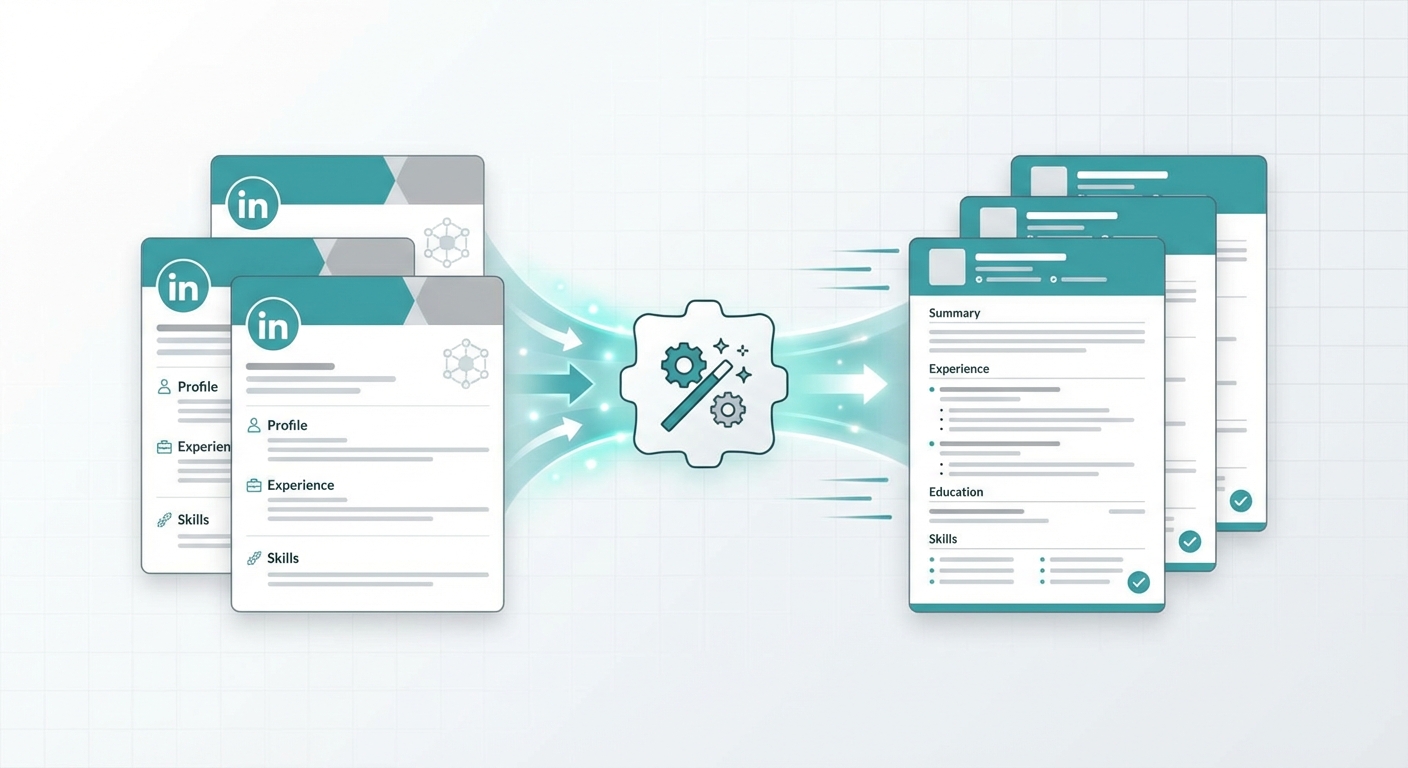
A practical guide to LinkedIn resume builders in 2026—why recruitment agencies rely on them, how they speed up submissions, and how teams convert LinkedIn profiles into consistent, client-ready CVs.
Recruitment agencies live on LinkedIn.
Candidates are sourced there.
Conversations start there.
Pipelines are built there.
Yet one step continues to slow teams down right before client submission:
Turning LinkedIn profiles into professional, client-ready resumes.
Copy-pasting content, fixing formatting, rewriting summaries, and reapplying agency branding may seem manageable—but across dozens or hundreds of candidates, it becomes a major operational bottleneck.
This is why the LinkedIn resume builder has become a critical tool for modern recruitment agencies.
In this article, we’ll explore what a LinkedIn resume builder really means in 2026, why agencies rely on it, and how the right solution improves speed, consistency, and scalability without adding admin work.
Why LinkedIn Resume Builders Matter More Than Ever
Recruitment teams operate under constant pressure.
Clients expect fast submissions.
Hiring managers scan CVs in seconds.
Competition is intense.
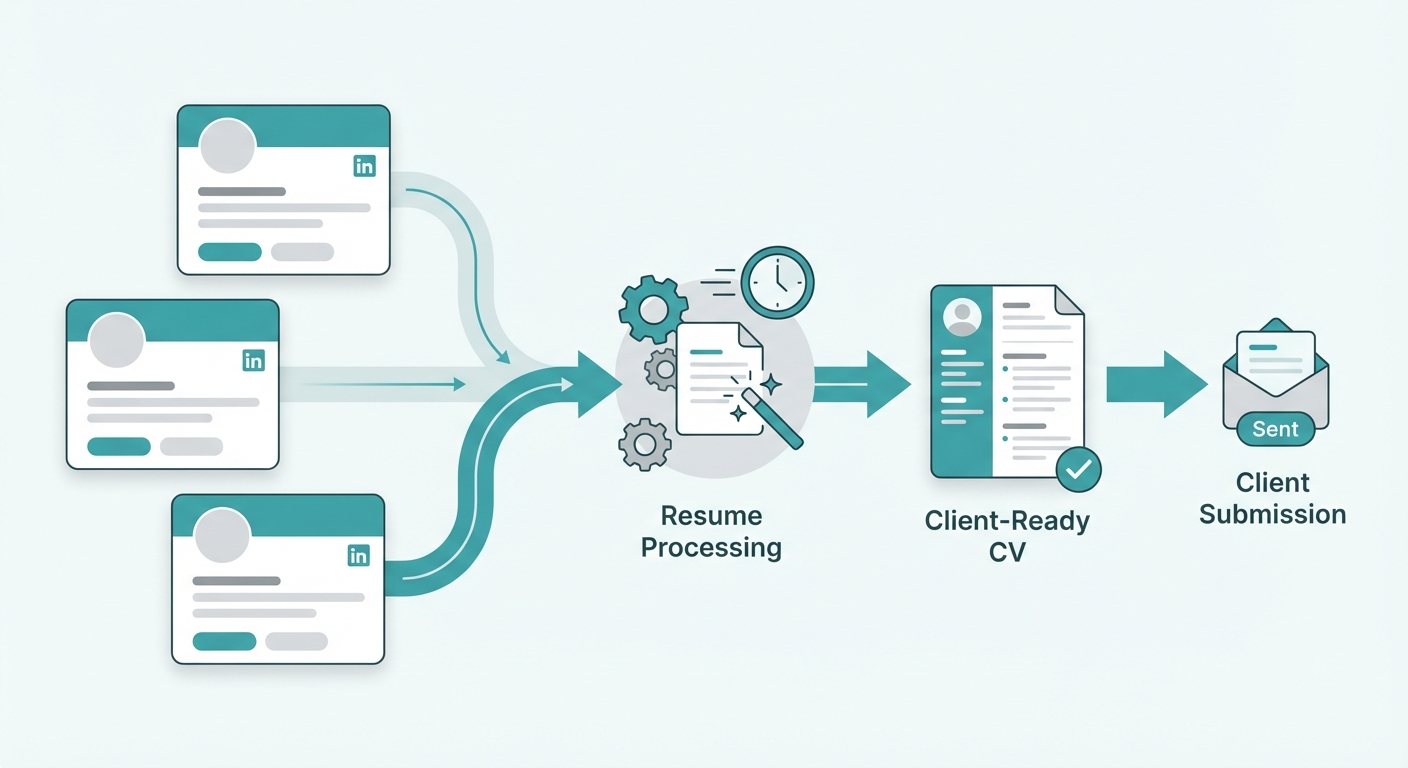
When LinkedIn profiles are submitted as-is—or converted inconsistently—the agency experience suffers.
A LinkedIn resume builder allows agencies to:
- standardise CVs created from LinkedIn profiles
- remove manual copy-paste work
- move from sourcing to submission faster
In competitive markets, this speed and consistency often decide who wins the role.
What Is a LinkedIn Resume Builder?
A LinkedIn resume builder converts LinkedIn profiles into structured, professional resumes.
For recruitment agencies, this typically includes:
- extracting experience, education, and skills
- restructuring content into an agency-approved CV format
- standardising headings, spacing, and layout
- ensuring resumes are easy for clients to scan
The goal is not to mirror LinkedIn.
The goal is to create client-ready CVs that fit recruitment workflows.
LinkedIn Profiles Are Not Built for Client Submissions
LinkedIn is designed for visibility, not submission.
Profiles often include:
- inconsistent section ordering
- vague summaries written for algorithms
- mixed formatting and date styles
- unnecessary or non-compliant personal details
As a result, recruiters aren’t just formatting—they’re rewriting and restructuring every profile.
A LinkedIn resume builder solves this by transforming raw profile data into a consistent, professional CV format.
The Hidden Cost of Manual LinkedIn-to-Resume Workflows
Without a LinkedIn resume builder, most teams rely on a manual process:
LinkedIn → copy & paste → Word template → formatting cleanup → review → client edits → new version.

This leads to:
- formatting inconsistencies across recruiters
- multiple file versions floating around
- unnecessary admin work during peak times
- higher risk of errors being sent to clients
At scale, this process simply doesn’t hold up.
Why Traditional LinkedIn Resume Builders Don’t Scale
Many tools marketed as LinkedIn resume builders are built for individual jobseekers—not recruitment teams.
Common limitations include:
- no support for agency-branded templates
- no bulk or repeatable workflows
- no collaboration across recruiters
- no compliance or anonymisation controls
Recruitment agencies need more than a one-off export.
They need a system.
How Recruitment Teams Use LinkedIn Resume Builders at Scale
High-performing agencies standardise LinkedIn-to-CV conversion across the organisation.
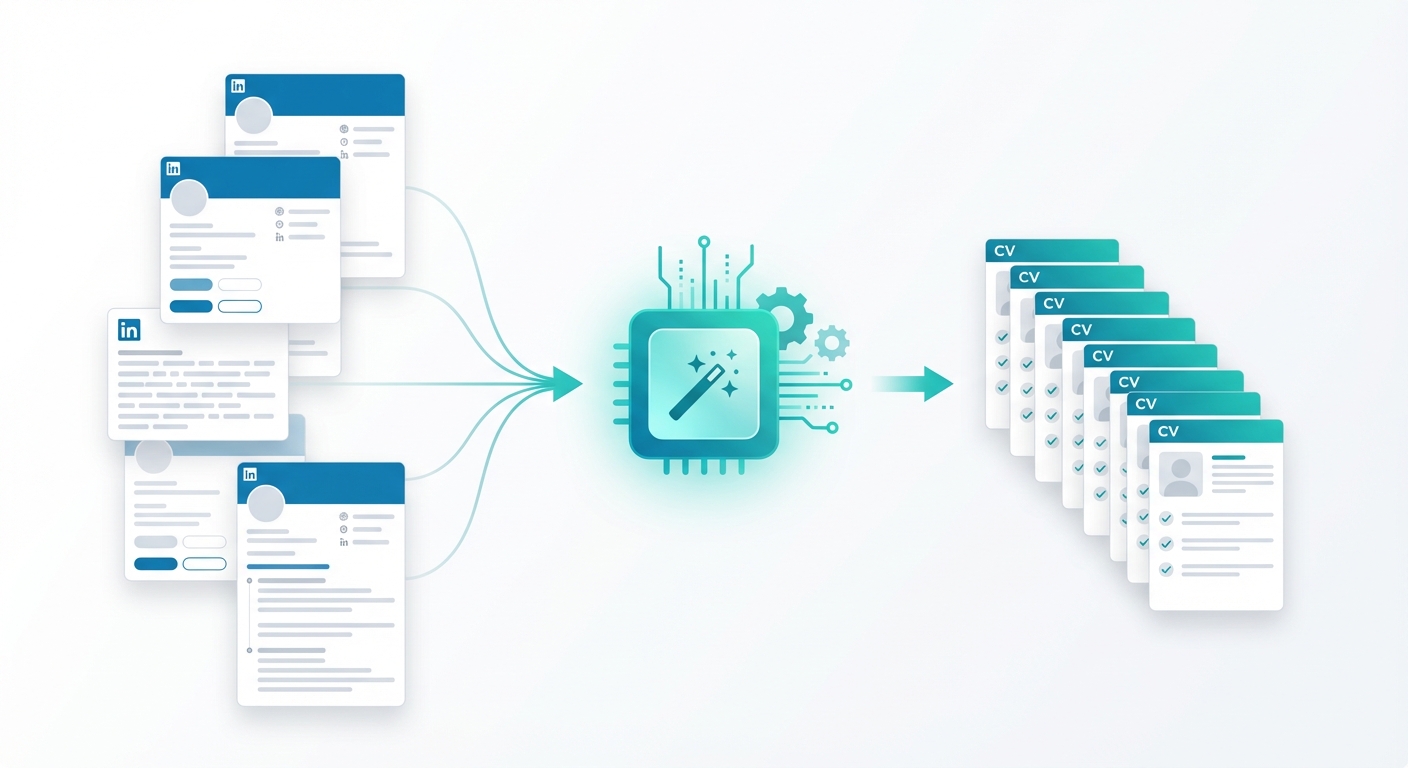
This typically involves:
- Defining approved CV templates
- Centralising formatting rules
- Automating LinkedIn profile conversion
This ensures every recruiter produces the same high-quality output—without slowing down.
The Role of Modern LinkedIn Resume Builders
Modern LinkedIn resume builders remove manual formatting and rewriting from recruiters entirely.
Instead of adjusting documents, recruiters focus on candidate relevance while the system handles:
- structure and layout
- consistent formatting
- standardised presentation
This is where tools like CVFormatter fit naturally into recruitment workflows.
CVFormatter allows recruitment teams to convert LinkedIn profiles into client-ready, branded CVs in seconds—without manual formatting.
Recruiters format once and reuse CVs across multiple submissions.
Book a free demo here.
LinkedIn Resume Builders Without Slowing Recruiters Down
A common concern is that LinkedIn resume builders add another step.
In practice, the opposite happens.
With the right system:
- recruiters spend less time on admin
- submissions move faster
- CV quality becomes predictable
LinkedIn-to-resume conversion becomes invisible—embedded directly into the workflow.
LinkedIn Resume Builders Across Different Use Cases
LinkedIn resume builders are rarely one-size-fits-all.
Agencies typically use them for:
Client Submission CVs
Clean, easy-to-scan resumes.
Anonymised Resumes
Used for compliance or bias-free screening.
Executive and Consulting CVs
Designed for senior roles where presentation matters more.
A strong LinkedIn resume builder supports all of these without duplicating work.
LinkedIn Resume Builders and ATS Compatibility
Converted resumes must still work inside ATS environments.
This means:
- clean document structure
- predictable section hierarchy
- no formatting that breaks parsing
CVFormatter produces ATS-friendly outputs while maintaining consistent formatting—allowing CVs to flow smoothly through recruitment systems.
Measuring the ROI of a LinkedIn Resume Builder
Agencies often underestimate the ROI of a LinkedIn resume builder.
The impact shows up quickly:
- faster time-to-submit
- fewer internal revisions
- reduced admin workload
- improved client perception
At scale, saving even a few minutes per LinkedIn profile translates into hours reclaimed each week.
LinkedIn Resume Builders as a Competitive Advantage
In crowded recruitment markets, small operational advantages compound.
Agencies that convert LinkedIn profiles into polished, professional CVs:
- stand out visually
- feel more organised
- inspire greater client confidence
A LinkedIn resume builder becomes part of the agency’s value proposition—even if clients never explicitly mention it.
Final Thoughts
LinkedIn will continue to be where candidate information lives.
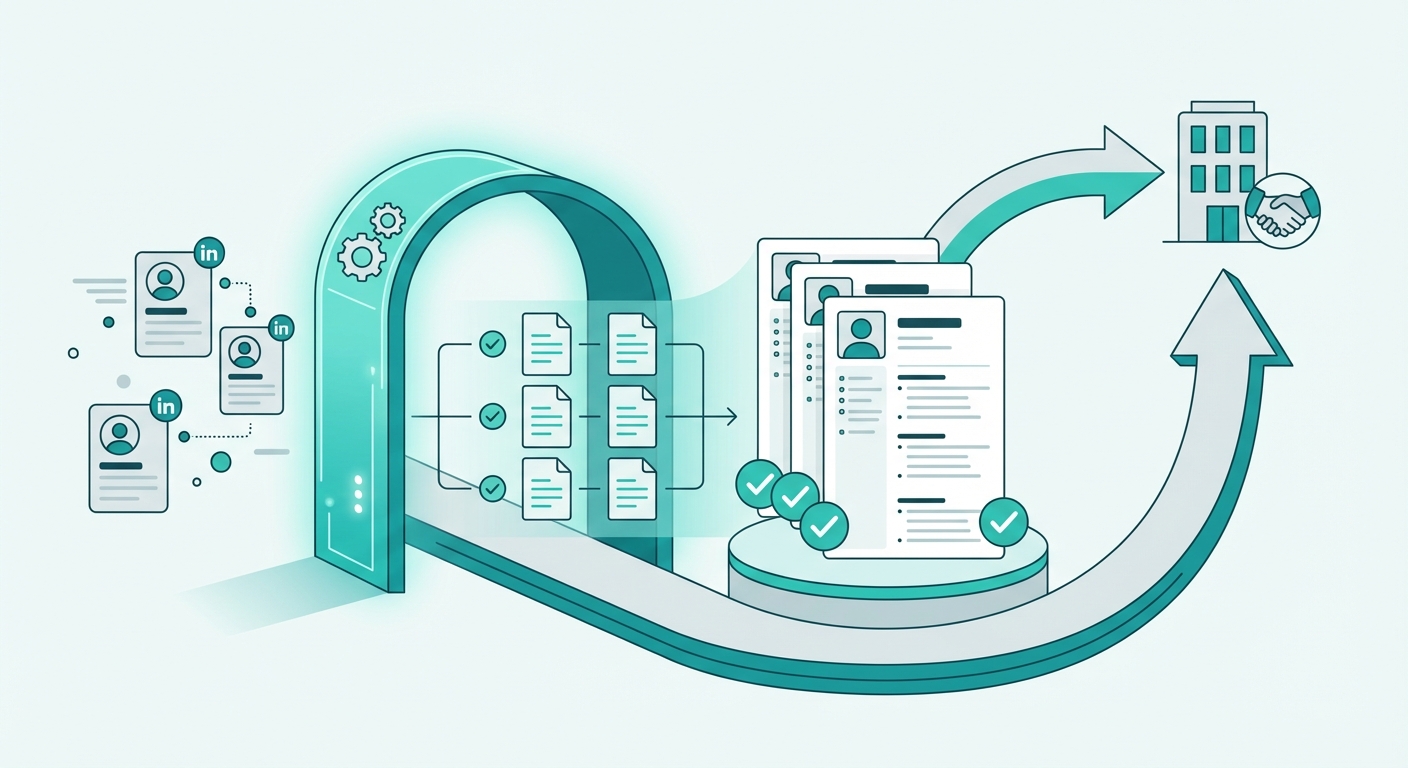
The competitive advantage lies in how efficiently recruitment teams turn that information into client-ready resumes.
In 2026, a LinkedIn resume builder is no longer a nice-to-have—it’s a core recruitment capability.
If your team is still copy-pasting LinkedIn profiles into Word, it may be time to rethink how LinkedIn fits into your resume workflow.
Most CV formatting tools don't support LinkedIn URL import — including several well-known alternatives. See how CVFormatter compares on LinkedIn import and other key features.
Book a free demo to see how CVFormatter helps recruitment teams convert LinkedIn profiles into fast, consistent, client-ready CVs—without slowing recruiters down.