Recruitment agencies handling high CV volumes have two options: outsource formatting to a service provider or automate it with software. Here's the honest comparison — turnaround times, cost per CV, quality control, data handling.
Every recruitment agency processing CVs at volume eventually asks the same question: do we outsource CV formatting to a service provider, or do we automate it with software?
Both approaches have advocates. Both have real trade-offs. And both models coexist in the market — outsourced CV formatting services from providers like Damco, Computyne, and various freelance/Fiverr offerings compete alongside SaaS platforms like CVFormatter, RemakeCV, Allsorter, and others.
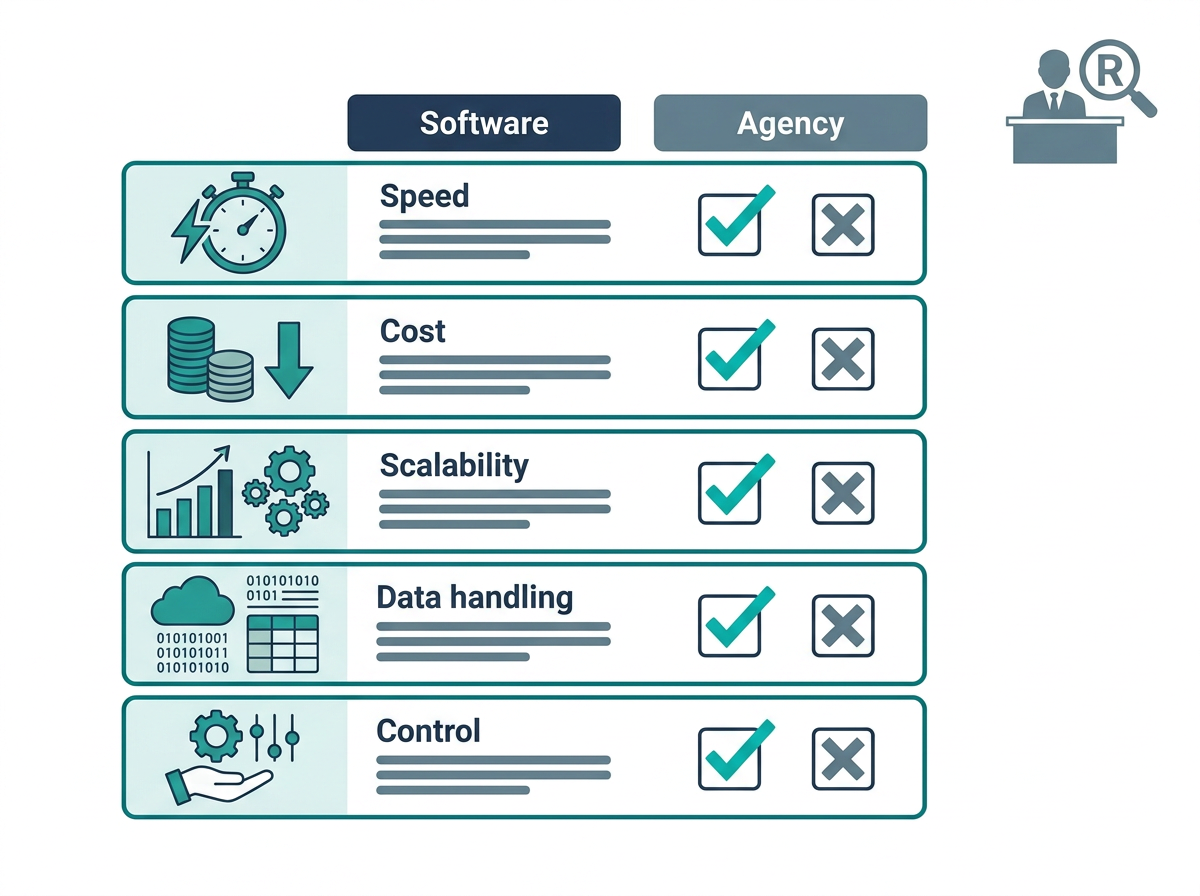
The honest answer isn't universal — it depends on your agency's volume, workflow, and priorities. This guide compares the two approaches directly on the dimensions that matter most: cost, turnaround time, quality control, data handling, and how each model scales.
The Two Models Explained
Before comparing, it's worth being clear about what each model actually delivers.
Outsourced CV formatting services are third-party providers who reformat your candidate CVs on demand. You send raw candidate CVs to the vendor via email or portal. The vendor's team manually applies your agency's template (which you provide) and returns the formatted document within their contracted turnaround time. Common providers include Damco Solutions, Computyne, various Fiverr freelancers, and specialist BPO firms in India and the Philippines. Pricing typically ranges from $2-$15 per CV depending on turnaround urgency and complexity.
CV formatting software is a SaaS platform your team uses to reformat CVs themselves — automatically. Upload a candidate CV to the platform, and the software parses it, applies your agency's branded template, and produces formatted output in seconds. Pricing is typically subscription-based, from around $79/month at the entry level up to enterprise plans at $500-$2,000/month depending on volume and features.
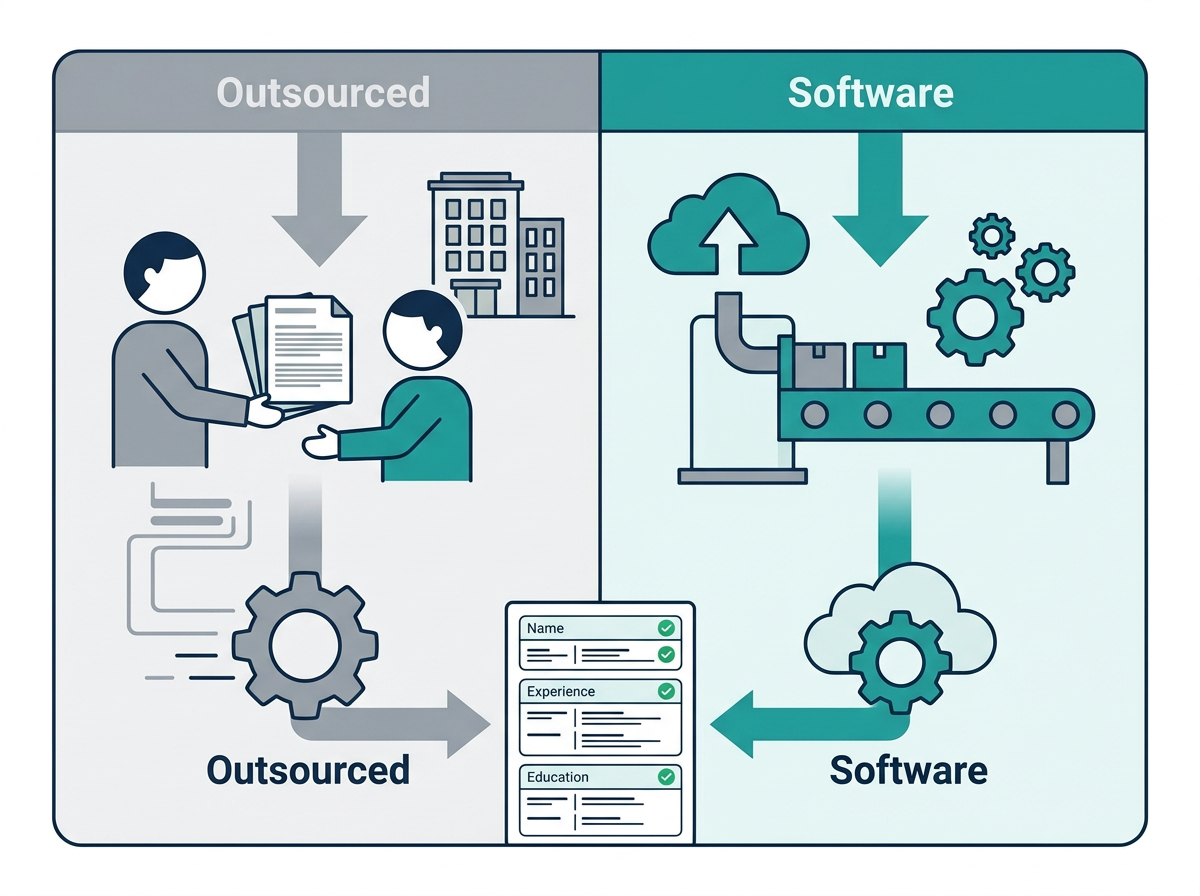
Both models achieve broadly the same outcome — a formatted, branded CV ready for client submission. The differences show up in how they get there.
Comparison: Turnaround Time
Outsourced services: Standard turnaround is 24 hours. Rush orders (2-4 hours) are typically available at 2-3× the base rate. Same-hour turnaround is possible with some vendors but priced accordingly.
CV formatting software: Seconds per CV. A shortlist of 8-10 candidates can be formatted in minutes rather than hours.
Verdict: Software is fundamentally faster. For agencies competing in the same-day submission windows that now dominate active mandates, outsourced services often can't keep pace at reasonable cost. If your workflow has a 4-hour submission window and your outsourced provider offers 24-hour turnaround, the model breaks structurally — you'd need to pay rush pricing on every submission, which erodes the cost advantage.
Comparison: Cost per CV
Outsourced services:
- Standard rate: $2-$5 per CV
- Rush rate: $6-$15 per CV
- Volume discounts often available above 500 CVs/month
CV formatting software:
- Subscription: $79/month for 100 CVs = $0.79/CV
- Higher volume subscription: $299/month for 500 CVs = $0.60/CV
- Annual plan: $758/year for 1,200 CVs = $0.63/CV
- PAYG credits: $89 per 100 credits = $0.89/CV, never expire
Verdict: Software is 3-10× cheaper per CV once volume exceeds 50 CVs/month. For agencies processing under 20 CVs a month, outsourced services can be cost-competitive. For anyone above that threshold, software is significantly cheaper.
There's a specific edge case: if your agency has very lumpy volume (busy weeks followed by quiet ones), outsourced per-CV pricing has some flexibility that fixed subscription doesn't. However, CVFormatter's PAYG credits (which never expire) largely address this — you buy credits when you need them, and they stay in your account until used.
Comparison: Quality Consistency
Outsourced services: Consistency depends on the vendor's quality control processes. Good vendors deliver reliable output; less good vendors produce variance across different formatters. Turnover on outsourced formatting teams tends to be high, which can introduce quality drift over time.
CV formatting software: Consistency is structural. The template is applied automatically, so every CV your team processes produces identical formatting. No per-formatter variance.
Verdict: Software has a structural advantage on consistency, but the quality of individual formatting depends on the software's parsing accuracy. If the software can't reliably parse your candidates' actual CVs (particularly complex layouts, scanned documents, or LinkedIn imports), the consistency argument breaks down. CVFormatter's 98%+ parsing accuracy across PDF, DOCX, image files, and LinkedIn URLs specifically addresses this.
Comparison: Data Handling and Privacy
Outsourced services: You send candidate CVs — often containing personal information — to a third-party vendor. This triggers GDPR/POPIA/CCPA data processing agreement requirements. For clients with strict data handling policies (particularly in financial services, healthcare, and public sector), this is often a blocking issue.
CV formatting software: Candidate data stays within your agency's account on the SaaS provider's platform. This is still technically a third-party data processor relationship, but it's structurally different — the software vendor doesn't have human staff reviewing individual CVs.
Verdict: Software offers cleaner data handling for most compliance requirements. For agencies handling sensitive candidate data (finance, healthcare, senior executive) or working with clients that have strict compliance requirements, this is often the deciding factor.

Comparison: Control and Iteration
Outsourced services: If a formatted CV isn't quite right, you send it back for revision. This introduces a delay cycle — often another 4-24 hours before the revised version comes back.
CV formatting software: The recruiter can adjust the output immediately. Re-run the formatting, apply different anonymisation, use a different template. Iteration is immediate.
Verdict: Software gives recruiters direct control. This matters most for time-sensitive submissions where waiting for revisions from an outsourced provider isn't viable. It also matters for agencies with high standards — the recruiter can immediately check and adjust output rather than trusting the outsourced formatter got it right.
Comparison: Team Access and Collaboration
Outsourced services: Typically one central account manages the vendor relationship. Individual recruiters submit CVs through a shared workflow.
CV formatting software: Access depends on the vendor's pricing model. Some tools charge per user (which can compound significantly across large teams). CVFormatter is unlimited users at no per-seat cost.
Verdict: Per-seat software pricing punishes team growth. Outsourced services don't scale by seats. CVFormatter's unlimited team model gives you the flexibility of outsourced access without the cost.
When Outsourced Services Actually Make Sense
Despite the general advantages of software, outsourced CV formatting still fits specific agency profiles:
Very low-volume boutique agencies processing under 20 CVs/month. Software subscription costs may exceed per-CV outsourced pricing at this scale.
Agencies without technical adoption capacity. Introducing new software creates change management friction. For very small teams (1-2 recruiters) where operational overhead is a real constraint, outsourced services can be simpler to adopt.
One-off high-touch projects. For specific executive search assignments requiring bespoke document design rather than repeatable template application, outsourced human formatters may deliver a more polished result than template-based automation.
Agencies with heavily customised layouts that don't fit a template-based system. Some legacy agency layouts require specific per-CV manual adjustment that automation can't replicate. This is increasingly rare, but it exists.
Bridge/transition periods. Some agencies use outsourced services temporarily while their internal team learns to use new software, or during major workload spikes that exceed their normal capacity.
When CV Formatting Software Actually Wins
For most recruitment agencies, software is the stronger choice. Specifically:
Agencies processing 50+ CVs a month. The cost differential becomes significant at this volume.
Agencies competing on same-day submission windows. Outsourced services can't reliably deliver at this speed at reasonable cost.
Agencies with strict data handling requirements. Software keeps data more contained.
Agencies with growing teams. Unlimited-user software scales; per-seat pricing doesn't; outsourced services scale predictably but expensively.
Agencies wanting operational control. Software gives recruiters direct control over the formatting workflow.
Multi-brand operations (RPO providers, multi-vertical agencies). Software with multi-template support handles this elegantly; outsourced services often struggle with multi-brand consistency.
What About Hybrid Approaches?
Some agencies use both models simultaneously:
Software as the default, outsourced services as backup. Most CVs go through the software workflow; specific complex documents (highly designed executive profiles, bespoke consultant profiles) go to an outsourced formatter for manual attention.
Software for standard submissions, human formatters for anonymisation quality check. Some agencies use software for the bulk workflow but have a human review step for high-stakes blind submissions.
Software during business hours, outsourced overnight coverage. Global agencies with 24/7 operations sometimes use offshore outsourced services to cover overnight formatting demand.
These hybrid models can work, but they add operational complexity. For most agencies, picking one primary model and running it consistently produces better results than trying to split the workflow.
How CVFormatter Handles the Full Workflow
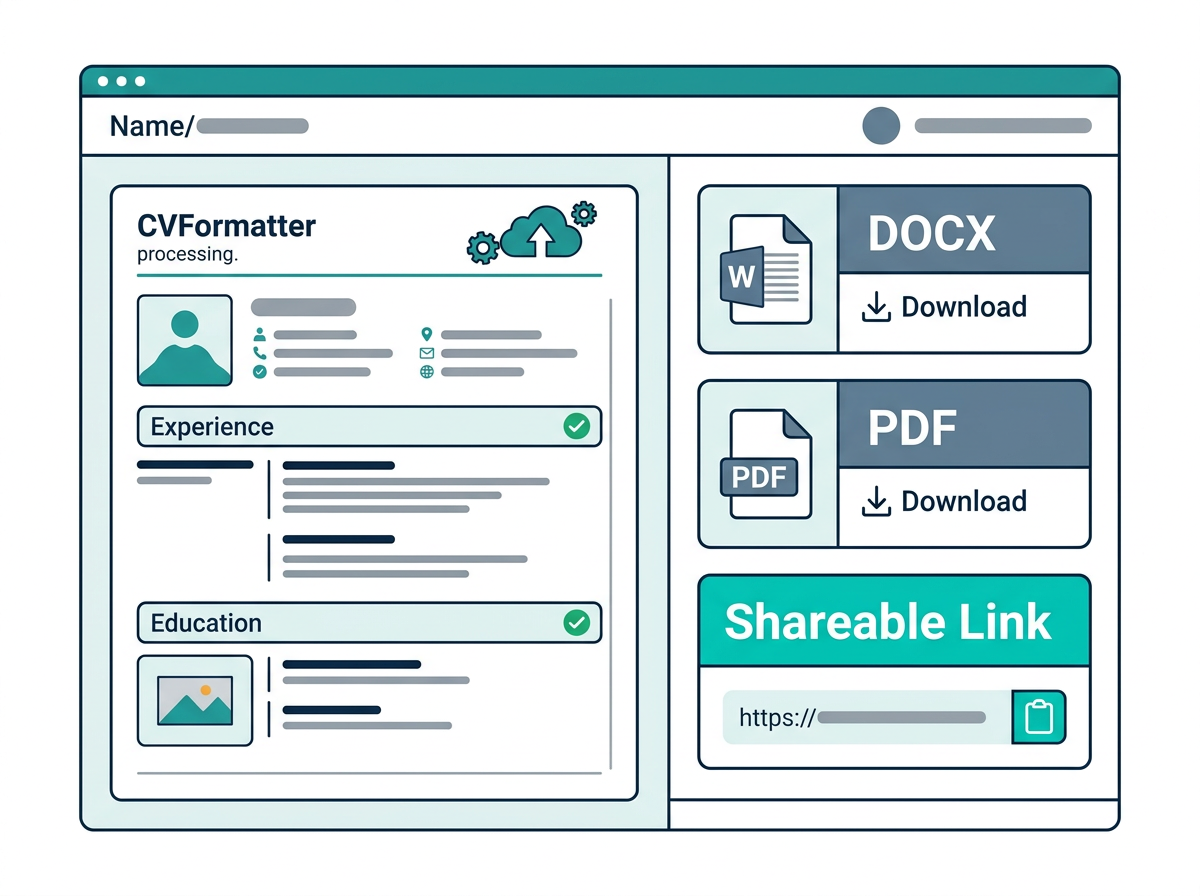
CVFormatter is used by recruitment agencies specifically because it handles the full CV formatting workflow — parsing, template application, standardisation, anonymisation, and multiple export formats — within a single tool.
Supported input formats:
- PDF (recommended for accuracy)
- Word DOCX (note: Word files sometimes contain hidden graphics or text boxes that can reduce parsing accuracy — PDF is usually the safer choice from candidates)
- PNG, JPEG, JPG (image files, processed via OCR)
- LinkedIn profile URLs (direct import)
Output formats: DOCX, PDF, and shareable link.
Key features: 98%+ parsing accuracy, unlimited team members at no per-seat cost, multi-template support, AI proofreading and summarisation, anonymisation with industry descriptor replacement.
Pricing: From $79/month for 100 CVs; PAYG credits at $89 per 100 CVs, never expiring; annual plans at $758/year for 1,200 CVs.
Book a free demo here to see how the software model compares to your current outsourced workflow.
Quick FAQ
Q: Can I switch from outsourced formatting to software gradually? Yes. Most agencies run a hybrid model during transition — new submissions go through software, existing outsourced pipeline finishes naturally.
Q: How do I calculate whether software or outsourced is cheaper for my agency? Simple math: multiply your average monthly CV volume by both models' per-CV cost. For most agencies above 50 CVs/month, software is significantly cheaper.
Q: Will my team actually use software? Modern CV formatting software is designed for zero-training adoption — most recruiters figure it out in 15 minutes. The learning curve is much lower than most operational tools.
Q: What if we have a mix of standard and highly bespoke CV requirements? Software handles the standard workflow; the bespoke requirements can either be handled with additional templates ($49 each in CVFormatter) or with occasional outsourced/manual attention on specific documents.
Final Thoughts
The outsourced vs. software decision for CV formatting isn't binary. Both models exist in the market for genuine reasons, and there are agency profiles that fit each.
For the majority of recruitment agencies — those processing 50+ CVs a month, competing on speed, managing team growth, and working with clients that expect fast submission — software is structurally the better model. It's faster, cheaper per CV, more consistent, better on data handling, and more scalable.
For agencies with very low volume, bespoke requirements, or specific transition circumstances, outsourced services can still fit. But this is a shrinking segment of the market.
If you're currently outsourcing CV formatting and haven't run the numbers on switching to software recently, it's probably worth doing. The unit economics have shifted significantly over the past 18 months.
Start your free trial or book a demo to see how CVFormatter compares to your current outsourced CV formatting workflow.